Nommon receives the ITS & Big Data award at the 25th Spanish ITS Congress
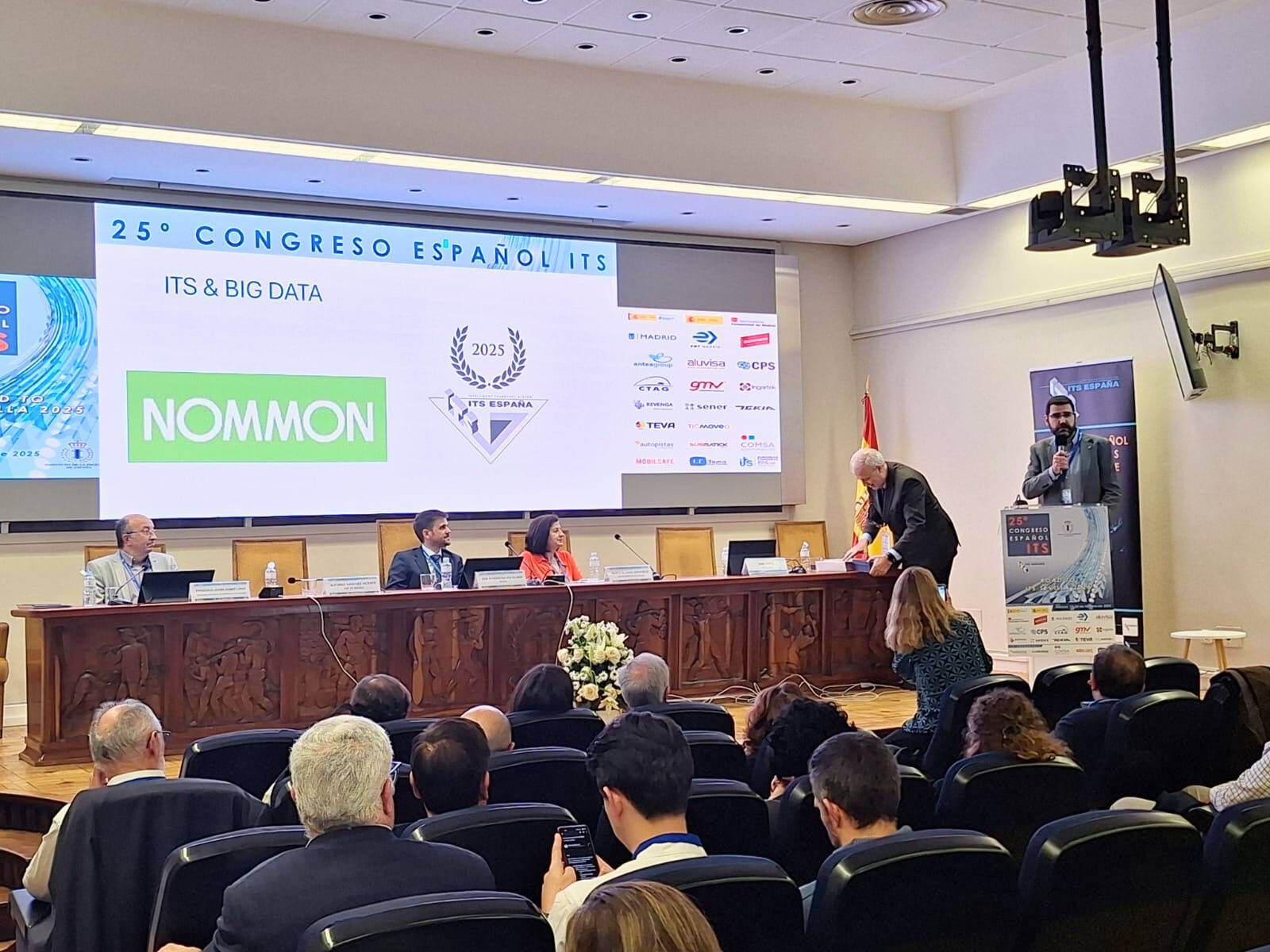
The jury has recognised Nommon’s trajectory as a pioneering company in mobility data analysis in Spain, the technical expertise of its team, and its contribution to the transport sector.
As part of the Spanish ITS Congress, held from 18 to 20 February 2025 at the Institute of Engineering of Spain, Nommon was awarded the “ITS & Big Data” prize for its pioneering trajectory in mobility data analysis in Spain, the technical capabilities of its team, and its contribution to the transport sector. The jury highlighted Nommon’s expertise in developing creative solutions and new approaches to data analysis and transport modelling, positioning the company as a global leader in mobility analytics. The award was announced by Jaime Huerta, Secretary-General of ITS Spain, and presented by Francisco Javier Gómez López, Director of Strategic Planning and Operations of the Madrid Regional Transport Consortium, during the congress’s closing ceremony on Thursday, 20 February. Ricardo Herranz, CEO of Nommon, received the award and expressed his gratitude, highlighting the hard work of the entire Nommon team and the importance of collaboration with clients, researchers, and industry stakeholders to continue innovating and launching projects that enhance knowledge sharing and promote transport sustainability.
This year, the congress celebrated its 25th edition, once again bringing together numerous professionals from the sector to discuss advancements in intelligent transport systems. The theme of this edition, “Road to ITS Sevilla 2025,” marked the transition towards the European ITS Congress, which will take place in Seville in May 2025. Throughout the event, key projects in the ITS field were presented, and discussions were held on new technologies and trends related to transport digitalisation and sustainability. Topics included the challenges and opportunities of autonomous and connected mobility, improvements in interurban traffic, the deployment of low-emission zones, the use of data for mobility management, data spaces, and the optimisation of public transport.